On this page
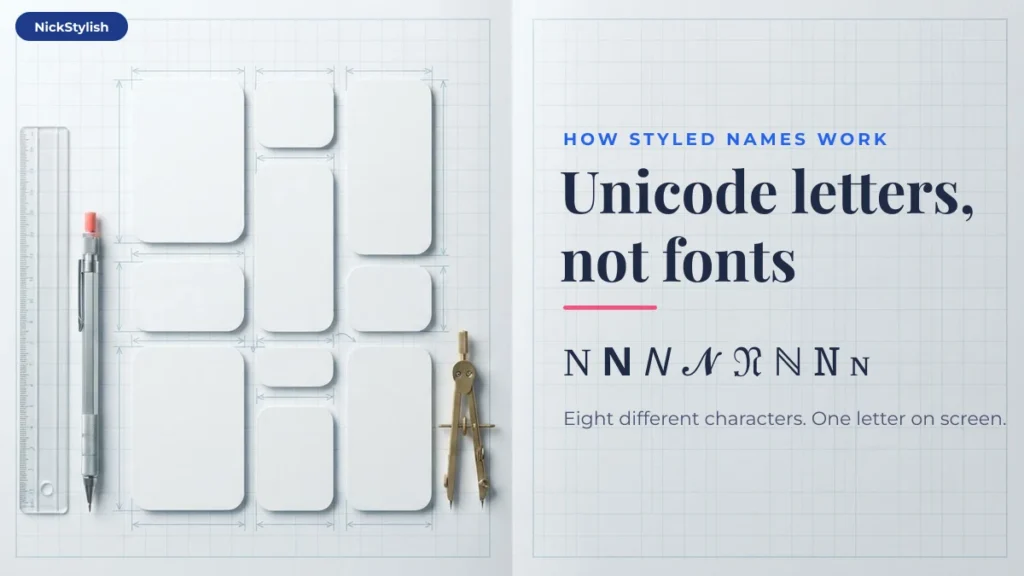
Stylish letters such as 𝐍𝐢𝐜𝐤 or 𝓝𝓲𝓬𝓴 are not a font. Each one is a separate Unicode character that happens to look like a styled letter, which is why the look survives copy and paste into apps with no font settings — and why some name fields reject it or turn it back into plain text.
This page is NickStylish’s reference for how that works: which Unicode blocks the styled alphabets come from, what happens when a name field “normalises” your text, why small capitals behave differently, why a short fancy name can hit a length limit early, and why some phones show empty boxes. Every code point, count and normalisation result below was generated with Python’s unicodedata module (Unicode 13.0 data) and cross-checked with PHP’s ICU library (Unicode 15.0 data) in September 2026.
What a “fancy font” name really is
A styled nickname is a string of different characters, not ordinary letters wearing a different font. The plain capital N is U+004E; the bold N you paste into a bio is U+1D40D, a character with its own name, Mathematical Bold Capital N. The phone draws each one with whatever font it has for that code point.
A font changes how the same character looks, and that choice lives in the app — a word processor can make your text bold without changing a single character. A copy-and-paste name cannot carry font settings, so generators swap the characters themselves. That is the whole trick, and it explains everything else on this page: styling that travels, fields that refuse it, and counts that come out higher than expected.
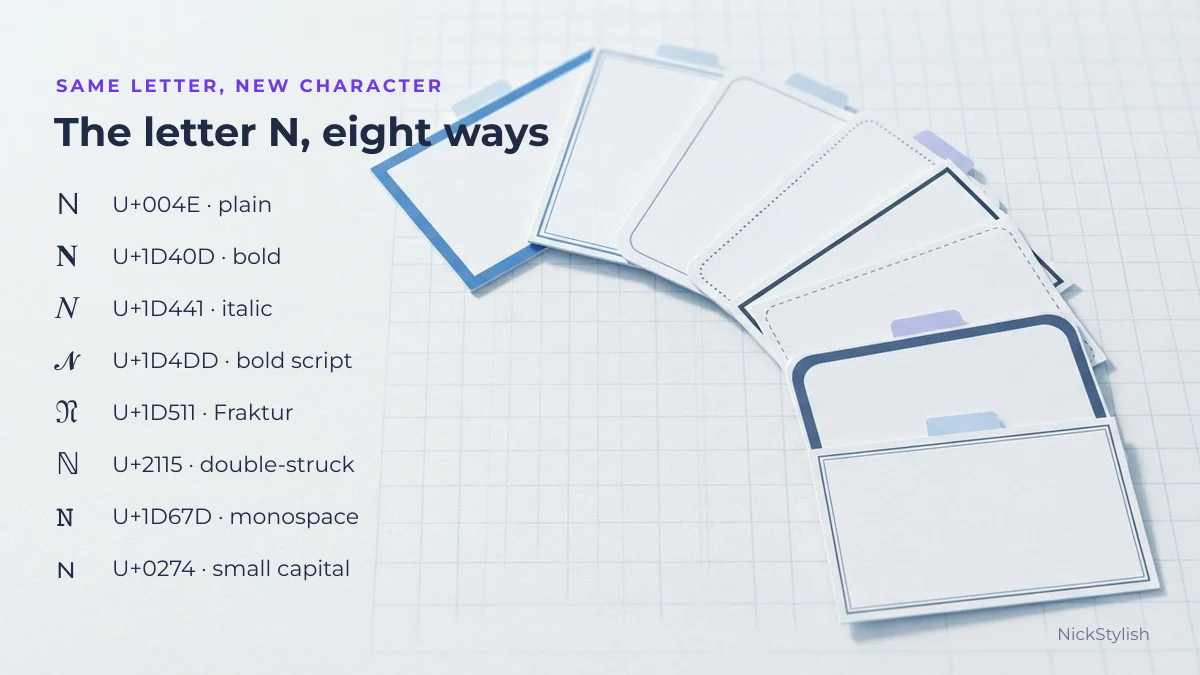
One letter, eleven characters: where each style lives
The same visible “N” can come from at least six different Unicode blocks. The table lists eleven common forms with their official names, the block each belongs to, how many UTF-16 units it takes, and what it turns into after NFKC normalisation (explained in the next section). Tap any character to copy it.
| Style | Character | Code point | Official name | Unicode block | UTF-16 units | After NFKC |
|---|---|---|---|---|---|---|
| Plain letter | U+004E |
Latin Capital Letter N | Basic Latin | 1 | N | |
| Bold | U+1D40D |
Mathematical Bold Capital N | Mathematical Alphanumeric Symbols | 2 | N | |
| Italic | U+1D441 |
Mathematical Italic Capital N | Mathematical Alphanumeric Symbols | 2 | N | |
| Bold script | U+1D4DD |
Mathematical Bold Script Capital N | Mathematical Alphanumeric Symbols | 2 | N | |
| Fraktur | U+1D511 |
Mathematical Fraktur Capital N | Mathematical Alphanumeric Symbols | 2 | N | |
| Double-struck | U+2115 |
Double-Struck Capital N | Letterlike Symbols | 1 | N | |
| Sans-serif bold | U+1D5E1 |
Mathematical Sans-Serif Bold Capital N | Mathematical Alphanumeric Symbols | 2 | N | |
| Monospace | U+1D67D |
Mathematical Monospace Capital N | Mathematical Alphanumeric Symbols | 2 | N | |
| Fullwidth | U+FF2E |
Fullwidth Latin Capital Letter N | Halfwidth And Fullwidth Forms | 1 | N | |
| Circled | U+24C3 |
Circled Latin Capital Letter N | Enclosed Alphanumerics | 1 | N | |
| Small capital | U+0274 |
Latin Letter Small Capital N | IPA Extensions | 1 | ɴ |
Three patterns stand out. Most styled alphabets — bold, italic, script, Fraktur, sans-serif and monospace — sit in the Mathematical Alphanumeric Symbols block, U+1D400–U+1D7FF, outside the Basic Multilingual Plane. A few letters were encoded much earlier in Letterlike Symbols, so the double-struck capitals ℂ ℍ ℕ ℙ ℚ ℝ ℤ and letters such as ℬ ℰ ℱ ℋ ℐ ℒ ℳ ℛ and ℎ (officially the Planck constant) live there, and the matching slots in the math block are deliberately left unassigned. A generator that simply adds an offset to every letter lands on those empty slots and produces a name with holes in it. The third pattern is the small capital, which is a real phonetic letter rather than a styled copy of a Latin one.
What the Unicode Standard says about styled alphabets
The Unicode Standard is explicit that the math alphabets are not meant for decorating ordinary text. In the section on the Mathematical Alphanumeric Symbols block, the Unicode core specification, chapter 22, states that the characters “are intended for use only in mathematical or technical notation, and not in nontechnical text.”
That does not make pasting 𝓝𝓲𝓬𝓴 into a profile illegal or harmful — it is simply not what those characters were designed for, and it is the root of the practical problems below. Software that expects mathematics treats them as mathematics; software that expects names often strips them.
Why a styled name turns back into plain letters
When a field converts 𝓝𝓲𝓬𝓴 into “Nick”, it is almost always applying NFKC normalisation. NFKC (Normalization Form Compatibility Composition, defined in Unicode Standard Annex #15) replaces “compatibility” characters with their plain equivalents, and every styled math letter is defined as a compatibility variant of an ordinary letter.
Services normalise names for sound reasons: it stops two accounts from looking identical while being technically different, makes search work, and closes a common impersonation trick. The side effect is that the styling disappears. We ran NFKC on ten typical pasted names:
| Pasted name | After NFKC | What happened | Code points | UTF-16 units |
|---|---|---|---|---|
| Nick | Styling removed, letters kept | 4 | 8 | |
| Rahul | Styling removed, letters kept | 5 | 10 | |
| Nick | Styling removed, letters kept | 4 | 7 | |
| Nick | Styling removed, letters kept | 4 | 4 | |
| Nick | Styling removed, letters kept | 4 | 4 | |
| ɴɪᴄᴋ | Nothing changed | 4 | 4 | |
| ꧁༒Nick༒꧂ | Nothing changed | 8 | 8 | |
| ᴠͥɪͣᴘͫ | Nothing changed | 6 | 6 | |
| ★彡Nova彡★ | Nothing changed | 8 | 8 | |
| 🦋Nick | Nothing changed | 5 | 6 |
The results are consistent: bold, script, double-struck, fullwidth and circled letters all collapse to plain Latin letters. Small capitals, decorative symbols such as ꧁ and ༒, the combining marks in ᴠͥɪͣᴘͫ and emoji pass through unchanged, because none of them has a compatibility mapping to a plain letter. That is why a frame often survives a strict field even when the letters inside it do not. If you need to see exactly which characters a decorated name is made of, the stylish nick decoder lists every piece with its code point.
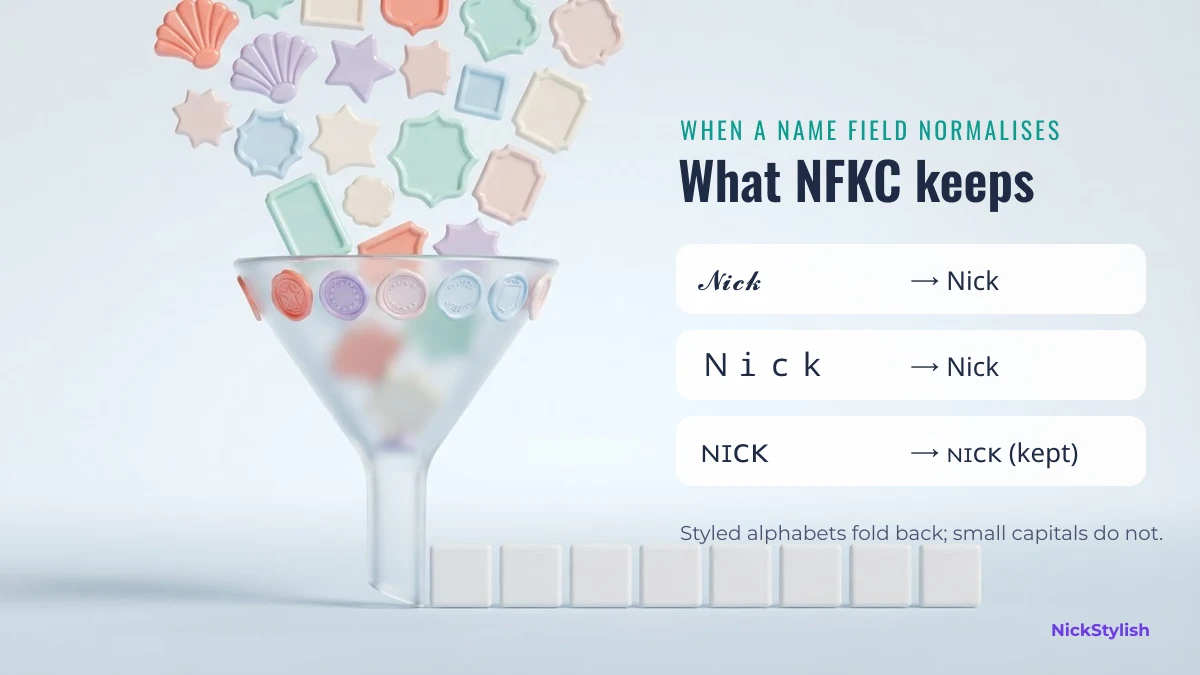
Small capitals: the style that survives, with gaps
Small capitals such as ɴɪᴄᴋ are the only common “fancy letter” style that NFKC leaves alone, because they are genuine letters from phonetic alphabets rather than styled copies. The catch is that the set was never designed as an alphabet: the letters were added over decades, from different blocks, for linguistic use.
| Letter | Small capital | Code point | Block | Added in Unicode |
|---|---|---|---|---|
| A | U+1D00 |
Phonetic Extensions | 4.0 | |
| B | U+0299 |
IPA Extensions | 1.1 | |
| C | U+1D04 |
Phonetic Extensions | 4.0 | |
| D | U+1D05 |
Phonetic Extensions | 4.0 | |
| E | U+1D07 |
Phonetic Extensions | 4.0 | |
| F | U+A730 |
Latin Extended D | 5.1 | |
| G | U+0262 |
IPA Extensions | 1.1 | |
| H | U+029C |
IPA Extensions | 1.1 | |
| I | U+026A |
IPA Extensions | 1.1 | |
| J | U+1D0A |
Phonetic Extensions | 4.0 | |
| K | U+1D0B |
Phonetic Extensions | 4.0 | |
| L | U+029F |
IPA Extensions | 1.1 | |
| M | U+1D0D |
Phonetic Extensions | 4.0 | |
| N | U+0274 |
IPA Extensions | 1.1 | |
| O | U+1D0F |
Phonetic Extensions | 4.0 | |
| P | U+1D18 |
Phonetic Extensions | 4.0 | |
| Q | U+A7AF |
Latin Extended D | 11.0 | |
| R | U+0280 |
IPA Extensions | 1.1 | |
| S | U+A731 |
Latin Extended D | 5.1 | |
| T | U+1D1B |
Phonetic Extensions | 4.0 | |
| U | U+1D1C |
Phonetic Extensions | 4.0 | |
| V | U+1D20 |
Phonetic Extensions | 4.0 | |
| W | U+1D21 |
Phonetic Extensions | 4.0 | |
| X | — | none | No small capital X is encoded | — |
| Y | U+028F |
IPA Extensions | 1.1 | |
| Z | U+1D22 |
Phonetic Extensions | 4.0 |
Two gaps matter for names. There is no small capital X in Unicode at all, so any generator that shows one is substituting a different character. And the small capital Q, U+A7AF, only arrived in Unicode 11.0, released in 2018. Phones and fonts that predate that version have nothing to draw for it, which is one of the most common real causes of an empty box inside an otherwise tidy small-caps name.
Why a fancy name hits a length limit early
A styled name can be rejected as too long even when it looks short, because many systems count UTF-16 units rather than visible letters. Characters inside the Basic Multilingual Plane (BMP, U+0000–U+FFFF) take one unit; characters beyond it, including every letter from the math block and most emoji, take two.
From the table above: 𝓡𝓪𝓱𝓾𝓵 is five visible letters but ten UTF-16 units, while ꧁༒Nick༒꧂ is eight units for eight characters because ꧁, ༒ and the letters are all in the BMP. In practice that means:
- Math-styled letters cost double in any field that counts UTF-16. A limit that fits a ten-letter plain name may fit only five bold letters.
- Classic decorations are cheap. ꧁ ꧂ ༒ ☬ ࿐ are single BMP characters, which is part of why they became the standard nickname frame.
- Some fields refuse anything outside the BMP, which rejects styled letters and emoji while still accepting BMP symbols. That is a common reason a game accepts ༒ but refuses 🔥.
- Invisible characters still count. A blank-looking filler adds units without adding anything you can see.
Which characters each game or app actually accepts is decided by that service, not by Unicode. Our guide to renaming in BGMI, PUBG Mobile and Free Fire covers the rules we could trace to a publisher, and the nick symbols collection shows the unit cost next to each decoration.
Why some phones show empty boxes or question marks
An empty box in place of a character means the device has no font that contains a drawing for that code point. The character itself is intact — paste it on a newer phone and it appears. It is a display gap, not corrupted text.
Coverage differs more than people expect. Math alphanumerics are well covered on current phones; the usual trouble spots are characters added to Unicode recently (the small capital Q is the classic example), letters from scripts the phone has no font for, and fullwidth forms on systems without East Asian fonts. Because the reader’s device decides, the same name can look perfect to you and broken to a teammate. The only reliable check is to paste the name where it will be used and look at it on another device.
Stacked marks and “glitch” text
Glitch or “Zalgo” text piles combining marks onto a base letter. Unicode sets an upper bound for well-behaved text: the Stream-Safe Text Format in UAX #15 limits a run to 30 consecutive non-starter characters, and text beyond that may be broken up by conforming software. Many apps apply far tighter limits of their own or strip combining marks entirely.
Moderate stacks, like the thirteen Thai tone marks in one of the samples below, usually display, but they overlap neighbouring lines and can make a name hard to read or tap. Decorative marks such as the enclosing circle in “Err ⃝or” behave the same way: they attach to the character before them, so deleting that character deletes the decoration too.
How screen readers handle styled letters
Assistive technology reads characters, not appearances. A screen reader that meets a math letter may announce its full character name, read nothing at all, or spell the word out letter by letter, depending on the reader and the platform. A name that is effortless to read on screen can therefore be slow or meaningless to hear.
If people who use screen readers matter in the space where you post, keep the readable core of the name in plain letters and put styling in the frame around it — ꧁ Nick ꧂ is kinder to a listener than 𝓝𝓲𝓬𝓴, and it survives normalisation as a bonus.
Why one app accepts a styled name and another refuses it
The same app can treat different fields differently. On Instagram, for instance, the @username accepts only letters, numbers, full stops and underscores, while the Name field accepts styled Unicode — the full breakdown is in our guide to Instagram’s three name fields. Game clients vary even more, and they change their accepted ranges between updates.
A quick way to predict the result: if a field is an identifier used to log in, mention or search for you, expect strict rules and normalisation; if it is a display label, expect more freedom.
Try it yourself: samples to paste and test
These strings each demonstrate one behaviour from this page. The small number on each chip is its UTF-16 length, so you can see the doubling effect before you paste. Try one in a strict field and in a relaxed one, and compare what comes out. The kaomoji group is a good normalisation test: many faces borrow fullwidth brackets and punctuation such as ( ) ; !, which NFKC quietly turns into their narrow ASCII versions, so a face can change shape without losing a single character. To build a name of your own in every style at once, use the NickStylish stylish nick maker.
Styled letters and small caps
Frames with a placeholder for your name
Combining marks and stacked accents
Symbols and dividers
Kaomoji with fullwidth punctuation
Emoji combinations
Questions that go beyond the characters themselves — renaming in games, blank names, privacy — are answered one by one in the stylish nick FAQ.
Frequently asked questions
Are stylish names made with a font?
No. They are made from different Unicode characters that look like styled letters. That is why they keep their look when pasted into apps with no font settings, and why some apps convert or reject them.
Why did my fancy name turn into normal letters?
The field applied NFKC normalisation, which maps styled math letters, fullwidth letters and circled letters back to plain ones. Small capitals and decorative symbols usually survive it.
Is there a small caps X?
No. Unicode encodes no small capital X, so every generator substitutes another character for it. The small capital Q exists but was only added in Unicode 11.0 in 2018, so older devices may show a box.
Why does my short styled name count as too long?
Math-styled letters and most emoji sit outside the Basic Multilingual Plane and take two UTF-16 units each. A field that counts UTF-16 sees a five-letter bold name as ten units.
Why do I see boxes instead of letters?
Your device has no font containing those characters. The text is not damaged; it will display on a device with wider font coverage.
Who wrote this, and how can I report a mistake?
This reference is maintained by the NickStylish editorial team; how we check facts is set out in the editorial policy. If something here is out of date, write to us through the contact page.